by Stacey | Feb 25, 2022 | Devotionals, reflections, and encouragement, Guest Posts
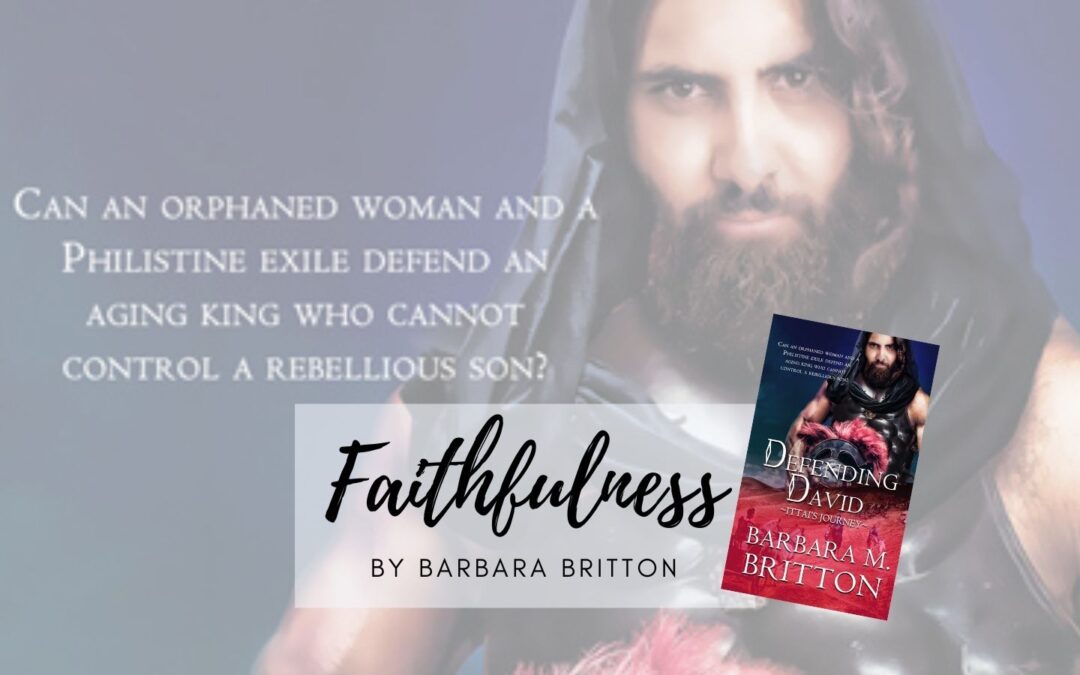
I’m a big fan of novels where opposites attract. I didn’t expect to write a book about friendship where the opposites were two men whose history would make them enemies.
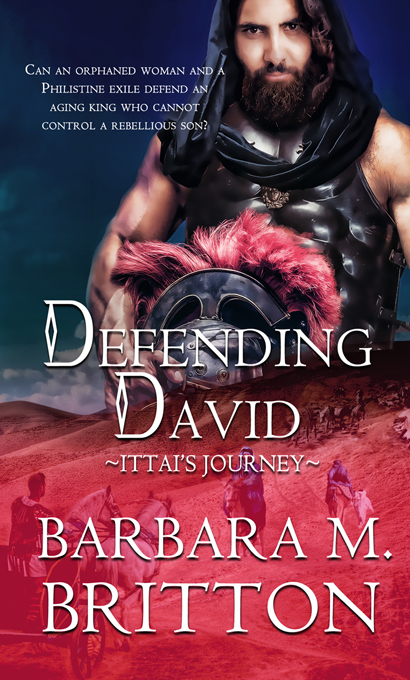
I enjoy writing biblical fiction about little-known Bible characters. In “Defending David,” I follow a Philistine exile who arrives in Jerusalem on the eve of a rebellion. The exile is a Philistine giant named Ittai the Gittite. Ittai sticks by King David’s side when David’s own son is trying to kill David and seize the kingdom.
If you look up faithfulness in the dictionary, you will find words like allegiance, loyalty, and devotion. As a Christian, we know those words apply to our relationship with God. What struck me as unusual is that Ittai the Gittite pledges loyalty to King David, but first, he pledges loyalty to the One True God. Huh? Weren’t the Philistines pagans, and at war with Israel for years?
You only have to go back to David’s childhood to see the animosity between the Israelites and the Philistines. David slayed Goliath—a Philistine giant—for insulting God. And even after Ittai’s appearance in II Samuel 15:21, we see Israel fighting the Philistines (again) in chapter twenty-one, verse fifteen.
So where is the faithfulness? Look at Ittai’s pledge of loyalty to David in II Samuel 15:21.
“But Ittai replied to the king, “As surely as the Lord lives, and as my lord the king lives, wherever my lord the king may be, whether it means life or death, there will your servant be.” (NIV)
Ittai pledges his faithfulness to God first and foremost. Then he pledges his faithfulness to David, a man after God’s own heart. (I Samuel 13:14). A foreigner who lived in a land of idols places God number one.
Being faithful to God and David will cost Ittai something. The Christian life isn’t always easy. Ittai and his fighting men have just arrived in Jerusalem after traveling across the desert. David tries to persuade Ittai to rest in Jerusalem and ally with Absalom, but Ittai refuses. He and his men will travel once more.
War is dangerous, Ittai will fight for David–God’s anointed king. He will have the responsibility to command a third of Israel’s army. (II Samuel 18:2). A Philistine leading an army of Hebrews? That is a miracle in itself.
So, what do we learn about faithfulness from a Philistine exile?
- God should be number one in our lives. Jesus said it succinctly in the Gospels, “Love the Lord your God with all your heart and with all your soul and with all your mind and with all your strength.” (Luke 12:30). A rephrase of Deut. 6:4-6.
- Ittai also loves his neighbor and friend, King David. Jesus mentions this in Mark 12:31 “Love your neighbor as yourself.”
- Loving and being faithful in your Christian witness isn’t easy. Ittai is tired from traveling. He risks his life to fight for King David. He does what he is gifted to do, and then some.
- Ittai knows that he serves a living God. How does he know God lives? Traveling with six-hundred Philistines across Israel wasn’t an easy feat. It could have been a disaster except for God. I’m assuming Ittai and his men prayed to the One True God. You cannot have a relationship with a dead, hand-carved pagan god, but you can have a relationship with God who is alive.
- We have God’s Living Word to guide us and encourage us on our Christian journey. We don’t know if Ittai had read some of Moses’ writings or heard tales of the parting of the Red Sea, or even heard David sing a psalm.
If a Philistine exile can place God first in his life and show faithfulness to the Living God, how much more can we today with the truth of Christ’s resurrection and the indwelling of the Holy Spirit. I’m thrilled to have discovered a new Bible hero who just happens to be a faithful Philistine giant.
When a quiet journey to Jerusalem turns tragic, newly orphaned Rimona must flee a kinsman set on selling her as a slave. Racing into the rocky hills outside of Hebron, Rimona is rescued by a rugged Philistine commander journeying to Jerusalem with six-hundred warriors. Can Rimona trust this giant foreigner, or will she be betrayed once again?
Exiled commander, Ittai the Gittite, is seeking refuge in the City of David. Protecting a frantic Hebrew woman is not in his leadership plan. Though having a nobleman’s niece in his caravan might prove useful for finding shelter in a foreign land.
As Rimona and Ittai journey to Jerusalem, an attraction grows between the two orphans looking for a new home. The unlikely pair arrives in Jerusalem on the eve of a revolt against King David. Will the chaos separate them forever, or can a bold woman and a Philistine exile defend an aging king who has slain tens of thousands, but cannot control a rebellious son?
Purchase on Amazon, B&N, or wherever books are sold. Libraries can order the book as well.
Barbara M. Britton lives in Southeast, Wisconsin and loves the snow—when it accumulates under three inches. She is multi-published in Biblical Fiction and loves bringing little-known Bible characters to light in her stories. Her WWI Historical Until June released in 2020. Barb is a member of the American Christian Fiction Writers, the Society of Children’s Book Writers and Illustrators, and Romance Writers of America. She has a nutrition degree from Baylor University but loves to dip healthy strawberries in chocolate. You can find out more about Barb and her books on her website at www.barbarambritton.com.
Or follow her on Instagram, Twitter, Facebook, Instagram, or BookBub.
by Stacey | Feb 17, 2022 | Devotionals, reflections, and encouragement, Guest Posts
Who are you?
The characters in my upcoming novel, To Belong Together, latched onto that question without my permission.
I set out to write a story about belonging, but John and Erin kept having conversations like this one:
“You’re John Kennedy, drummer for one of the biggest bands in the country.”
He shook his head as if to disagree, then laughed quietly. “And you’re Erin Hirsh, girl mechanic.”
“I’m a woman and a technician.”
His nod seemed a little smug, as though he’d anticipated her objection. “And a niece, cousin, and spitfire, but I bet daughter matters most.”
A spitfire? Okay, she deserved that, and he didn’t say it like an insult. Plus, he was right. Her role as daughter mattered most. Before Dad’s mind fell prey to dementia, he’d been the only person to understand and accept her. She didn’t belong with anyone the way she belonged with him.
Who will I be when he’s gone, God?
Do you see how seamlessly Erin’s thoughts progressed from roles to belonging to identity?
The three are connected. The identity we claim strongly influences where we believe we belong, and it’s all too easy to identify ourselves by the roles we fill.
Unfortunately, roles come and go. That’s why, when we base our identity on them, they can only provide a temporary sense of belonging—one that’s cast into upheaval when change comes, as Erin is experiencing.
But there is a secure, unchanging anchor for a person’s identity.
Jesus Christ is the same yesterday and today and forever. Hebrews 13:8, ESV
The unchanging, loving God crafted us with attention and purpose. (see Psalm 139:14 and Psalm 138:8)
He died on the cross so we could have a right relationship with Him.
When we believe in Him, we become His children, and that is an identity that will never change.
See what kind of love the Father has given to us, that we should be called children of God; and so we are. 1 John 3:1, ESV
I give them eternal life, and they will never perish, and no one will snatch them out of my hand. John 10:28, ESV
Operating from that identity, believers needn’t fear the other changes that come our way. In Christ, we will always have belonging.
John and Erin’s story helped me explore all of this, but as I look back on the story, I realize there’s another character who quietly lives out this example better than any other: Erin’s father.
The one with dementia.
Though his disease has progressed before the story starts, Erin recalls him telling her earlier on that he was willing to walk whatever road God assigned because anything God assigns, He walks His children through.
I think the willingness to accept such a difficult assignment points to a man who was secure in his identity as a beloved child of God. He was confident that even dementia, which threatened not only his roles in life but also his mind, couldn’t separate him from his God.
We live in an uncertain world, and we fill many, many roles over the course of a lifetime. If it’s the comfort and security of true belonging we’re after, then the only place we’ll find it is in Christ. When we base our identities in Him, we, like Erin’s father, needn’t fear any call, challenge, or change.
Fame and money have a way of complicating love.
Drummer John Kennedy can keep a beat, but he can’t hold a conversation, so he relies on actions to show he cares. Unfortunately, when he’s instantly intrigued by a spunky female mechanic, he can’t seem to convey the sincerity of his intentions. And the rejections don’t stop there. His own sister is pushing him away just when he could help her most.
Erin Hirsh’s life would be easier if God hadn’t given her a love for cars. Only her father understood her, and she’s losing him to dementia. Her brief romances have always backfired worse than a mistuned engine, and she refuses to give John the chance to wreck her heart. A rock star with a supermodel ex can’t possibly see anything in her.
At least that’s what she thinks until they find common ground in faith and their worsening family situations leave them each longing for a place to belong. Could God intend for this pair of opposites to belong together?
Emily Conrad writes contemporary Christian romance that explores life’s relevant questions. Though she likes to think some of her characters are pretty great, the ultimate hero of her stories (including the one she’s living) is Jesus. She lives in Wisconsin with her husband and their energetic coonhound rescue. Learn more about her and her books at emilyconradauthor.com.
To Belong Together, releasing 2/28/22, is the second novel in the Rhythms of Redemption Romances, where each story follows one member of the rock band Awestruck. Pre-order the ebook for the discounted price of $2.99 from major online retailers.
by Stacey | Feb 3, 2022 | Devotionals, reflections, and encouragement
The words burst from the depths. Like early rumbling foreshocks, they warn of the coming quake. “Because I said so!”
I struggle to speak with consistent gentleness. The day begins well, but by 9 pm, when my kids are still roaring with energy and mine is depleted, my tone sharpens. I justify my attitude by pointing out their disobedience. However, someone else’s sin never justifies mine.
Have you been there? Have you stood in the right shouting all the wrong words? Have you wielded your battle sword only to lose the larger war?
We know Proverbs 15:1, “A soft answer turns away wrath, but a harsh word stirs up anger.” We understand that people respond best to kindness, yet harshness pours easily from the overflow of an exhausted heart. It’s too easy to yield to the temptation to satisfy our flesh by releasing frustration. We fail to heed Galatians 6:1-3 because we think we are right.
At war with that prideful position of being right is the believer’s desire to walk worthy of our calling with all humility, gentleness, and patience, bearing with others in love (Eph 4:1-3). We are to “pursue righteousness, godliness, faith, love, steadfastness, gentleness. Fight the good fight of the faith …” (1 Timothy 6:10-12), and not be quarrelsome, able to teach, patiently enduring, correcting with gentleness in the hope God may grant him repentance leading to a knowledge of the truth (2 Timothy 2:24-26).
As I meditate on the verses that describe the woman the Lord is shaping me to become, I can’t help but notice they are packed with verbs. Action words require an active response from me. That means I stop passively waiting for God to supernaturally drop gentleness onto my tongue. I decide to believe that He has given me all I need in His Spirit to speak with gentleness at all times. And when I fail—because I will—I repent and humbly seek forgiveness from whoever I’ve wronged and God. Being right doesn’t permit me to treat a person made in the image of God harshly.
I don’t know where you are in your spiritual journey or how your relationships with others are growing and changing, but I expect some of you are like me, and you need to hear this correction. You need to hear the encouragement that God will meet us in exhausting moments, and He delights in giving us what we need to walk in obedience to Him; we only need to ask.
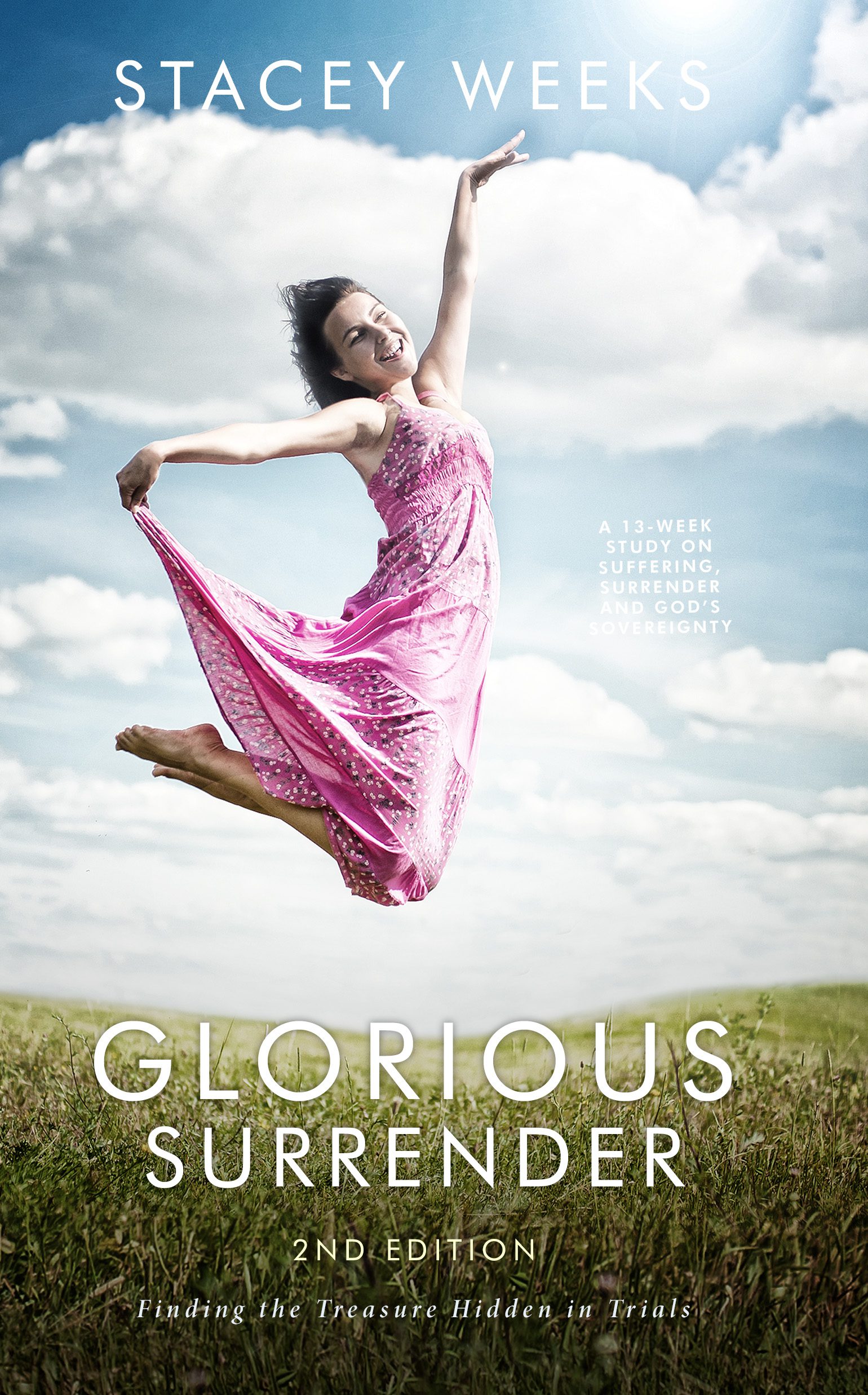
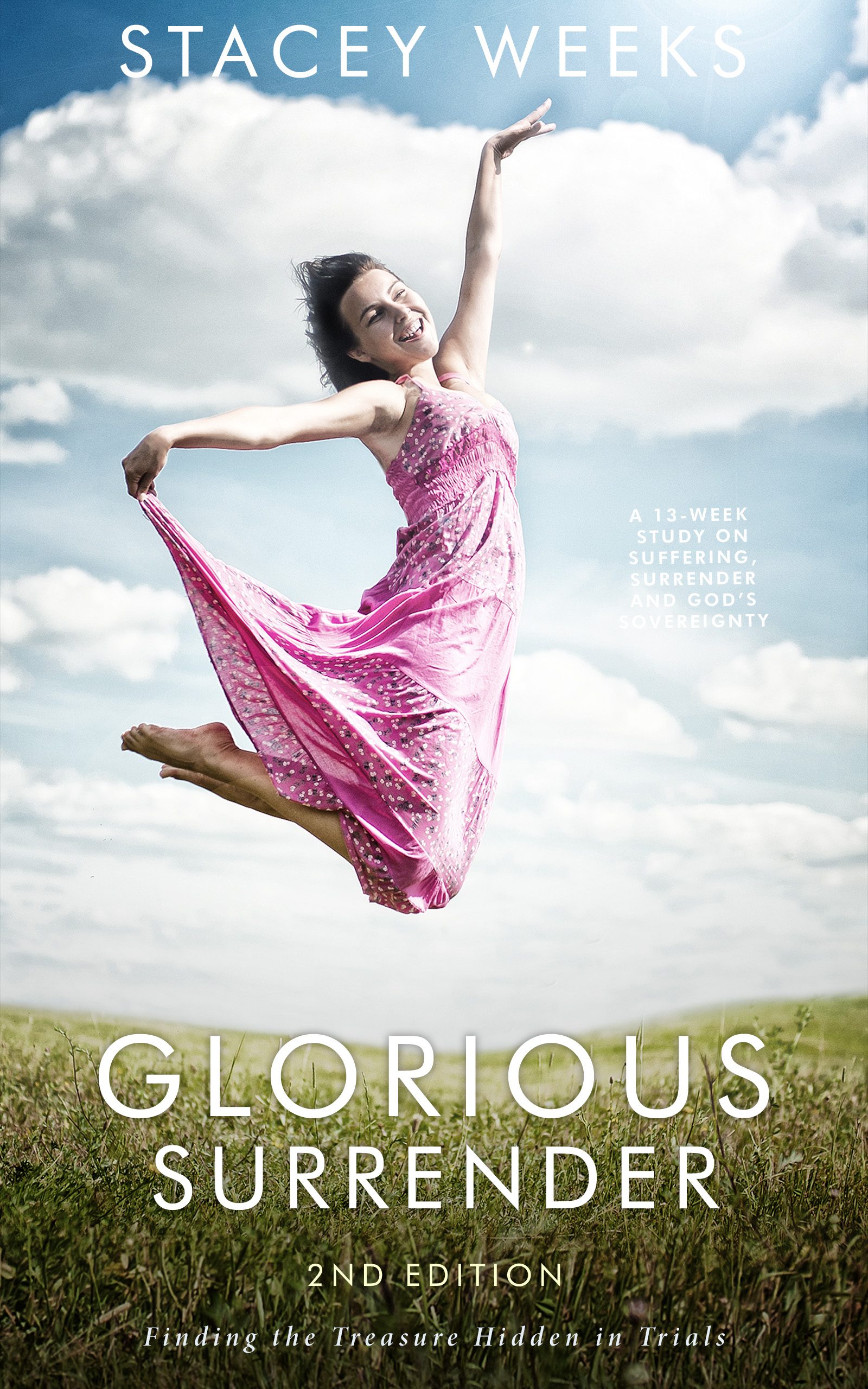
If you long for the kind of joy rooted in complete dependence on God, if you long for peace, trust, and contentment amidst alarming circumstances, check out the Second Edition of Glorious Surrender.
Winner of the Women’s Journey of Faith Award, Stacey Weeks invites you to travel with her through the thirteen chapters in Glorious Surrender and address the deeply rooted fears we have as mothers, sisters, daughters, and friends. Reflection questions designed to prompt deeper thinking and personal application can be done alone or in a group. Glorious Surrender concludes with five passages of Scripture along with study questions designed to walk you through the text and apply everything you have learned about suffering, surrender, and God’s sovereignty. Some of God’s greatest blessings are hiding behind those parts of our lives that are most difficult to surrender.
by Stacey | Jan 20, 2022 | Devotionals, reflections, and encouragement, Guest Posts
Most resolutions fail because they focus on cleaning the outside of the cup—behavior modification—without dealing with the internal factors that fuel our actions. True and lasting change goes much deeper, to that which drives everything else—our good habits and bad, our acts of love and sin, and our fears and our faith.
God revealed this truth to me decades ago when I was battling what seemed like an unconquerable eating disorder and intense emotions that often felt out of control. I went to church on Sundays and sang about the all-encompassing grace of Christ, determining to love others like He loved me, only to snap at my daughter, gossip about a friend, and get into an ugly fight with my husband once home. I was a mess, as was my marriage and some of my closest friendships. I knew I needed to live differently if I wanted to experience the joy and peace Christ promised, if I wanted to be the “new creation” Scripture proclaimed. (2 Cor. 5:17).
“Lord, help me, please,” I cried, night after night, making all sorts of promises to Him and myself. The next I day would be different. I’d be more loving, kinder. I’d use words that built up rather than tore others down and wouldn’t get so caught up with the bathroom scale or what I consumed. I’d read my Bible and pray more.
I developed quite a list of dos and don’ts, habits I wanted to incorporate and those I wanted to drop, and a strong desire to follow through. And if I tried hard, if I remained focused on my goals, I could reach them … for a few days, a week, sometimes even a month.
But I never found freedom.
Then one night, after having broken my vows yet again, I poured my heart out to God. I felt so weak, like such a failure. I remained there for some time, tears streaming down my face as all my flaws replayed through my mind. But then God shined His light deep into my soul, revealing the roots of my behaviors and why I wasn’t living in the victory Christ had already won for me.
My battle wasn’t over what I did or didn’t eat, say or do. My problem stemmed from my heart: misplaced loves. Idolatry of myself. Turning to food, entertainment, or shopping for comfort instead of pursuing the soul-deep healing that can only come from Christ.
That was a life-changing moment for me that I’ve never forgotten, one that has radically changed my goals. Because I know, if my heart is right and fully centered on Christ, everything else will follow. (Proverbs 4:23).
Or to phrase it differently: every behavior, the positive and negative, and accidentally blurted word, flows from the heart.
Set Goals
So, here’s what I plan to focus on in the year ahead:
- I will create margin in my day and week to sit quietly with my Savior, knowing anything good in me comes from Him. And I’ll learn to practice “the pause” more consistently—when I sense frustration, pride, or selfishness rising within, when anxious thoughts threaten my peace, or simply when I begin to feel fatigued. With God’s help, I’ll remember to close my eyes, to breathe deeply, and remind myself of His presence, if only for a moment, knowing every minute spent with Him fortifies my soul.
- I’ll trust God to fight my battles. My all-powerful Creator handles them much better than I do, anyway. He knows everything I’m facing, all that lies ahead, and how He plans to use it all for my good and His glory.
- I will learn to live in my true identity as His beloved and empowered child, because I know how identity impacts behavior. I won’t live as an orphan who must earn God’s love, who must hide from Him when I fail. Instead, I will consistently turn to Him, my tender and attentive Father, to receive mercy, strength and comfort in my time of need. (Hebrews 4:13). And I will listen for His guidance, knowing He is growing and healing me day by day and prayer by prayer.
Join me!
I invite you to join me as together, we choose growth over perfection and connecting with Christ over striving, because that is the life to which we’ve been called; the life Christ died to give us.
Consider that habit you’ve long tried to break, that behavior you’ve consistently fought against. What might God want to reveal regarding its root?
Jennifer Slattery is a speaker, author, podcast host, and founder of Wholly Loved Ministries. Learn more about her at Jennifer Slattery Lives Out Loud, or check out her social media profiles.
Amazon Author Page
Facebook
Instagram
by Stacey | Jan 6, 2022 | Devotionals, reflections, and encouragement
A New Year launches a new series on the blog. We spent some time in 2021 looking at our word choices, and 2022 builds on that theme to explore the fruit of the Spirit that is supposed to be evident in the believer’s life.
To prepare for the series, read Galatians 5:16-26. Paul shares two lists. One contains the desires of the flesh, and the other includes the fruit of the Spirit. Paul claims the works of the flesh are evident: sexual immorality, impurity, sensuality, idolatry, sorcery, enmity, strife, jealously, fits of anger, rivalries, dissensions, divisions, envy, drunkenness, and orgies. Those who do these things will not inherit the kingdom of God.
Dig a Little Deeper
Sometimes when we read a list like that, our mind goes to the worst-case illustration. For example, if you’re not having sex outside the boundaries of marriage, you might skip over “sexually immoral” without considering the other applications of that choice. Being sexually moral includes monitoring more than our actions; it also means considering our thought patterns, entertainment choices, and what we allow ourselves to consume (books, movies, websites etc.). Careful examination of the desires of the flesh might reveal more than we expect about the depths of our sin.
Examine and Apply
In the upcoming series, we will look at each fruit of the Spirit and examine how it applies in real-life moments. The focus of this series is the fruit. But, first, we must acknowledge that a battle rages for our hearts. There is a war between the desires of the flesh and the desires of the Spirit, and ignoring it will not make it go away. Acknowledge which desires of the flesh are the greatest struggle for you. Start by listing each one and searching for synonyms. For example, it’s easy to think I’m not a greedy person, but when I consider selfishness as a synonym, I can better see where that sin appears in my life. Next, find the fruit of the Spirit that combats that sin. Returning to our example of sexual impurity, we could argue that the fruit of self-control would counter that sin. Once you know what fruit you need to grow to combat your specific temptations, ask the Lord to help you nourish that seed.
I’m excited about this journey we are about to take together! Look for a new post in this series on the first Thursday of every month.
Looking for more?
Grab a few friends and one of these studies and commit to growing the right kind of fruit in your life.
by Stacey | Dec 30, 2021 | Devotionals, reflections, and encouragement, Guest Posts
We are in the season of giving. It’s a great time to give the gift of forgiveness.
Undoubtedly, Jesus understood forgiveness was not just a gift for the one who needs forgiveness it is just as much a gift for the one needing to forgive.
The inability or refusal to forgive traps us in the past, stopping us from moving forward with our lives. The resentment we carry makes us prisoner to the person or incident that brought us pain.
The problem most of us have with forgiving someone who has treated us unjustly or abused us is the feeling that we’ll be letting the person off the hook or in essence saying, “What you did to me was okay or didn’t have meaning”.
“Forgiveness does not mean excusing.”
C.C. Lewis
When what it’s actually saying is, “What you did, or what happened to me was wrong – it meant something, but I’m going to forgive you anyway… because, I’ve been forgiven.”
It’s not letting the person off the hook – forgiveness is like being given the key to a prison cell and unlocking the door walking out!
Forgive as Jesus
As Christians, we understand this, because Christ forgave us, while we were undeserving and unworthy of forgiveness. And, He tells us that we should do likewise. Instructing us in the Lord’s Prayer, “Forgive us our sins, just AS we forgive those who sin against us.” (Luke 11:4, NLT) This would indicate that our forgiveness is based upon our ability to forgive others.
I’m sure Jesus realized this often would not be an easy task.
Having had to practice what I preach, I know that it’s not.
And, I’ve ministered to and counseled with individuals who’ve been hurt in unspeakable ways – yet they found and gave the gift of forgiveness. The peace and freedom that followed were life-changing.
Someone to Trust
I use the theme of forgiveness throughout my novel Someone To Trust. In the story, Megan McCormick has suffered betrayal twice from men. She is wounded, angry and trapped in bitterness and mistrust. She’s put physical distance between her and the place where she was abandoned and betrayed, but she’s still emotionally trapped there. Her mistrust of men and guilt over past failures hinders her from stepping into a relationship with Lee, a handsome, kind Veterinarian. Only after accepting the forgiveness of her heavenly father is Megan able to forgive her earthly father and the man who broke her heart. However, her newfound freedom is put to the test when her past comes knocking. Now, there’s only one person left for her to forgive, and she struggles with this one most of all – herself. Can she give herself the gift of forgiveness and accept Lee’s love? You’ll have to read Someone To Trust to find out.
Now, back to the real world!
This really is the best time to give yourself the gift of forgiveness. We are truly the benefactors when we choose to forgive. And it is a choice – not a feeling.
“Forgiveness is an act of the will, and the will can function regardless of the temperature of the heart.”
Corrie Ten Boom
The gift of forgiveness and the freedom it brings is immeasurable. It’s liberating; it allows us to unchain ourselves from the past, make peace with it and move forward in our lives.